Is it mandatory for my community pool to be accessible?

The requirement to make community swimming pools accessible in Spain depends primarily on the current accessibility regulations and requests from residents with disabilities. These regulations are governed by the General Law on the Rights of People with Disabilities and Their Social Inclusion (RD 01/2013) and in regional or local regulations, in addition to the Horizontal Property Law (LPH).

In addition, the Technical Building Code (CTE) establishes, in its Basic Document on Safety of Use and Accessibility (DB-SUA), the requirements for buildings to be accessible. This applies to newly constructed buildings or those undergoing significant renovation.

In summary, we can state that adapting a swimming pool in a homeowners’ association is mandatory by default in all new construction or in extensively renovated communities. In older communities, it is not mandatory by default, but it becomes mandatory if requested by a resident with a disability or who is over 70 years of age, provided that the costs do not exceed the stipulated legal limit (not exceeding 12 regular monthly community fee payments). If the costs exceed that limit, the adaptation is optional, unless the homeowners’ association decides to cover the cost.

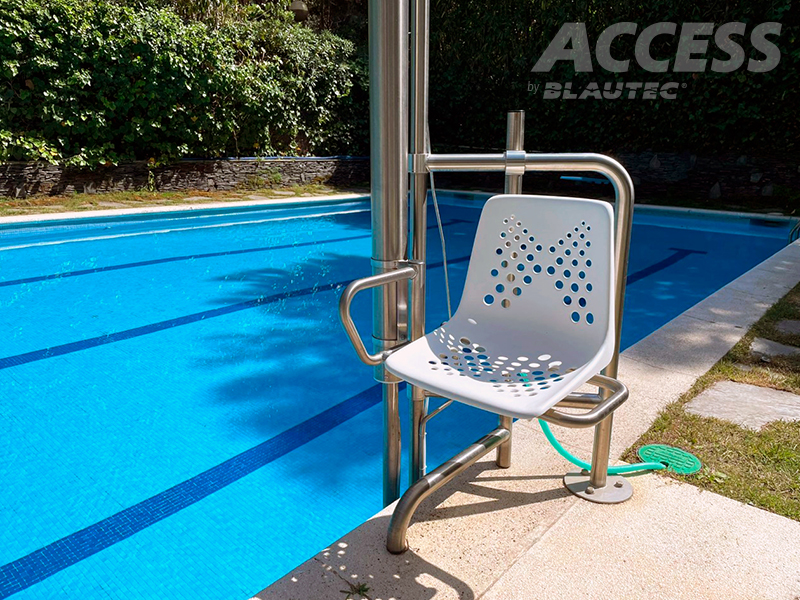
One of the best solutions for improving accessibility to the community pool is to install a hydraulic pool lift. Its easy installation (no major construction required), high durability, minimal maintenance, and its convenience and autonomous operation are factors that lead many homeowners’ associations to choose ACCESS lifts (manufactured in Spain).
Accessibility Regulations for Swimming Pools in Spain

In accordance with Royal Legislative Decree 1/2013, dated November 29, which approves the Consolidated Text of the General Law on the Rights of People with Disabilities and Their Social Inclusion, it is mandatory to carry out the necessary renovations—whether by installing pool hoists or cranes, constructing ramps, or installing other mechanical or electronic devices on the premises—so that these facilities comply with the basic conditions of accessibility and non-discrimination.

Furthermore, Article 10 of the Condominium Law also establishes the obligation to carry out these modifications so that anyone can use the common areas.

In addition to making swimming pools accessible, these changes must also be implemented in gardens and other sports areas. This regulation applies only to public facilities or homeowners’ associations. We must remember that it is the responsibility of all property owners to ensure access and prevent discrimination based on disability, so that all members of the community can enjoy the same benefits.

The costs of the renovations will be the responsibility of the property owners, provided that the annual amount involved in the work—after deducting subsidies and public aid—does not exceed twelve ordinary monthly payments of common expenses.

How can you make a community pool accessible?

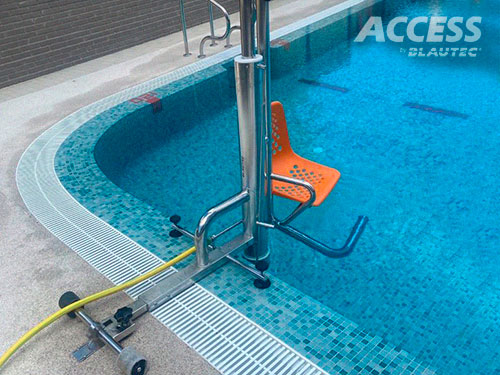
To make the pool accessible to everyone, the homeowners’ association must approve the installation of a pool lift. One of the most recommended solutions is a hydraulic pool hoist with an ergonomic seat that facilitates access to the pool.

There are also other options, such as renovations to replace stairs with ramps (provided the pool’s dimensions allow it), but it’s worth noting that the safest, quickest, and easiest option is the installation of a lift for people with disabilities.

The regulations described above do not specify which type of equipment or solution must be used; it is up to the community to make this decision based on the needs of the facilities and the owners. What is mandatory, however, is that accessibility features be certified to meet safety, compliance, and autonomy requirements.

ACCESS offers accessibility solutions for public and private pools. We help resolve access issues with our certified pool lifts, so that all pools comply with current accessibility regulations and everyone can enjoy the benefits of swimming regardless of their condition.

The new model ACCESS B5 has recently become the most sought-after option among homeowners’ associations. Its compact structure, elegant design, and more affordable price make it the ideal pool lift for homeowners’ associations.

Examples of Accessible Pools with ACCESS

Accesibilidad en piscinas de comunidades de vecinos

Requena Regional Aquatic Center

Lift model: ACCESS B5
Location: Requena (Valencia)

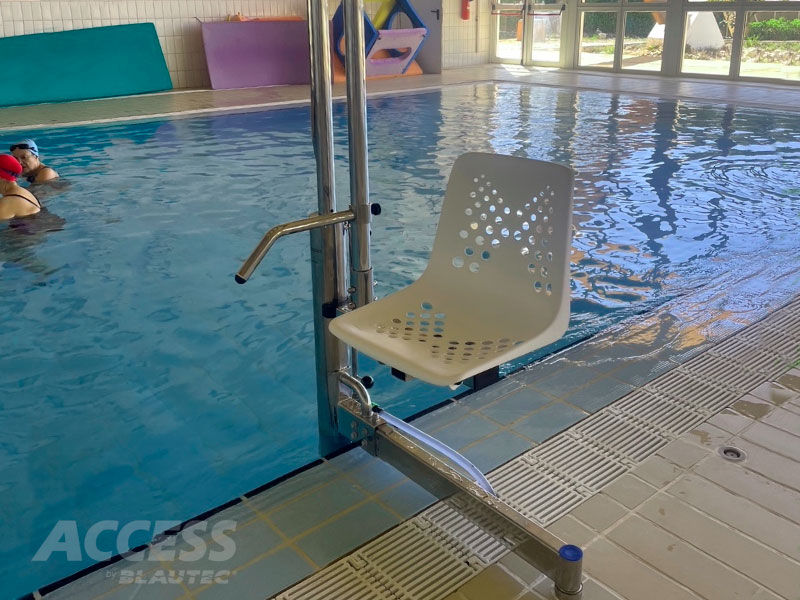
The Requena Aquatic Center has replaced its old hydraulic lift with the new ACCESS B5 pool lift.

Accesibilidad en piscinas de comunidades de vecinos

Accessible community pool in Barcelona:

Lift model: ACCESS B4
Location: Barcelona

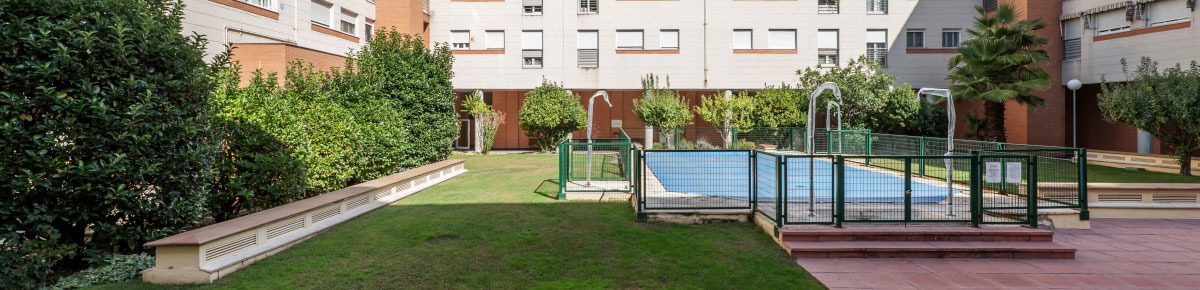
A homeowners’ association has installed an ACCESS B4 lift in its community pool to make it easier for one of its residents to get into the water.

Now Sandra can freely enjoy her community’s pool. What’s more, she’ll be able to do so without needing assistance, thanks to the independence the lift provides.

Accesibilidad en piscinas de comunidades de vecinos

Accessible community pool at A. López in Madrid:

Lift model: ACCESS B1
Location: Madrid

In 2021, the homeowners’ association installed an ACCESS B1 lift in its community pool to facilitate access to the water for all residents, specifically adapting to the needs of two of its residents with mobility issues.

Product added to compare.