The Blautec ACCESS pool hoists are manufactured in AISI 316L stainless steel structure and polypropylene pool hoist, both materials are totally suitable for outdoor use and with minimum corrosion levels.

What are the properties of 316 stainless steel?

316 stainless steel is an austenitic chromium-nickel steel containing 2 to 3% molybdenum.The molybdenum content increases corrosion resistance, improves resistance to pitting in chloride ion solutions and increases high temperature resistance.

Additionally, it is particularly effective in acidic environments and serves to protect against corrosion caused by sulfuric, hydrochloric, acetic, formic and tartaric acids, as well as acid sulfates and alkaline chlorides, in which the crane may be exposed.

Known as marine grade, grade 316 has many variants. The most common are given the letters L, F, N and H; each is slightly different and used for different purposes.Here, the "L" designation means that 316L steel has less carbon than 316.

Silla ascensor para piscina para accesibilidad de piscinas

What are the physical properties of steel type 316L?

- Density: 0.799g / cm2.
- Electrical resistance: 74 microhm - cm (20o Celsius).
- Specific heat: 0.50 kilo Joules / kg - Kelvin (0 - 100o Celsius).
- Thermal conductivity: 16.2 watts / meter-Kelvin (100o Celsius).
- Modulus of elasticity (MPa): 193 x 10 3 in tension.
- Melting range: 2,500 - 2,550o Fahrenheit (1,371 - 1,399o Celsius).

As for the percentages of the elements used to create these alloys, they are:

ELEMENT

TYPE 316L (%)

Charbon

0.03 max.

Manganese

2.00 max.

Phosphor

0.045 max.

Azufre

0.03 max.

Silicon

0.75 max.

Chrome

16.00 - 18.00

Nickel

10.00 - 14.00

Molybdenum

2.00 - 3.00

Nitrogen

0.10 max.

.

What are the qualities of 316L stainless steel?

316L stainless steel exhibits better corrosion resistance and is stronger at elevated temperatures.

It is also hardenable by heat treatment and can be easily formed and drawn. Annealing (treatment that reduces hardness and increases ductility or the ability to accept plastic deformation) of 316L stainless steel requires a heat treatment of between 1038o - 1149o Celsius before quenching.

Some of its other qualities are as follows:

- It is durable and a good choice for high stress situations.
- High resistance to corrosion.
- Suitable for projects with a lot of welding.

What are the properties of polypropylene?

Polypropylene (PP) is the thermoplastic, partially crystalline polymer obtained from the polymerization of propylene (or propene). It belongs to the polyolefins group and is used in a wide variety of applications including food packaging, textiles, laboratory equipment, automotive components and transparent films. It has high resistance against various chemical solvents, as well as alkalis and acids.

The properties of isotactic Polypropylene, commercially known as Polypropylene, PP or hPP, is very similar to polyethylene, except for the following specifications:

- Lower density: PP has a specific gravity between 0.9 g/cm³ and 0.91 g/cm³, while the specific gravity of LDPE (low density polyethylene) ranges between 0.915 and 0.935, and HDPE (high density polyethylene) between 0.9 and 0,97 (in g/cm³)

- Higher softening temperature

- High resistance to stress cracking

- Higher tendency to be oxidized (problem usually solved by the addition of antioxidants)

- PP has an intermediate degree of crystallinity between high and low density polyethylene.
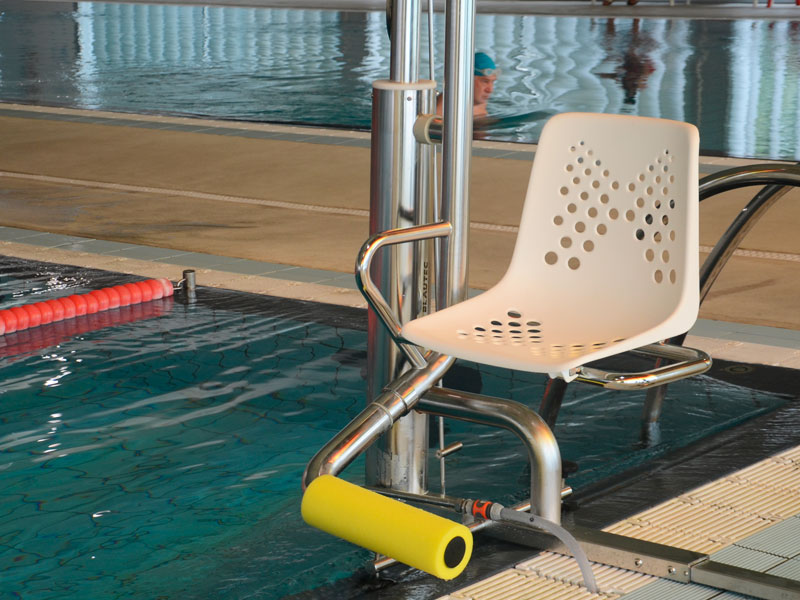
At Blautec we work every day with the aim of making swimming pools more accessible, designing with the best quality materials our pool hoists for People with reduced mobility. That's why the price of each pool hoist is adapted to the needs of each client, and our sales team customizes each of the budgets.

Product added to compare.

We use our own and third-party cookies for analytical purposes and to show you personalised advertising based on a profile of your browsing habits (e.g. pages visited). For more information, please see our Cookie Policy